Showing posts with label Dentist. Show all posts

Tuesday, 27 October 2015

How Well do you know your teeth?


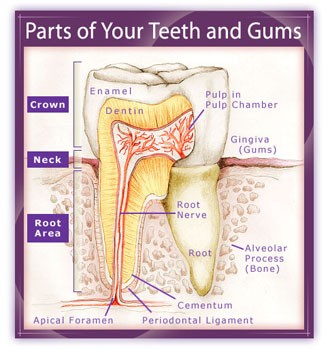
PartsTeeth- getting to know your teeth-2015-10-14.jpg
As adults, we know the value of taking care of our teeth. As children, we have to be taught not only about our teeth but why taking care of them is so important. If we were to ask people how many teeth they have many may  not be able to answer without counting. This led us to believe that we should share what we know about the tooth.


We have 32 as adults. Children have less and begin to lose them at about age six. Losing our baby teeth is a rite of passage and the first sign of growing up. Parents coo over this by saving teeth and pretending to be the tooth fairy.  We continue to lose our baby teeth into our teens. Our permanent adult teeth replace all those baby teeth we lost plus some. As adults we have 8 incisors, 4 canines, 8 premolars, and 12 molars, these include our 4 wisdom teeth.


Our teeth are the first step in the digestive process. We use all parts of our mouth to chew, cut up and begin to digest our food. Our teeth help us break apart the food and our saliva begins the process of digesting that food. Our teeth are located in our upper and lower jaw bones and are supported by gingival tissues (better known as gums). A tooth is similar to a plant; some parts you can see and some parts you can't. The part of the tooth that can be seen is called the 'crown.' It would be similar to the flower and stem of the plant. It is the viable portion of the tooth. The neck is the section between the tooth and root, it is small and located where your gums are. The root area is the remaining part of the tooth, and is the buried part of the tooth, much like a plant’s root systems. A tooth’s root system extends past the  gums and  into the jaw bone. We call these root systems or roots  the 'dental root.'


Along with these parts of the tooth, the tooth is also made up of various layers. We will go from outside in. The outer part of the crown (the part of the tooth you can see) is covered by enamel. That Enamel is a very hard substance rather like a crystal. This enamel helps protect our teeth from daily wear and tear. Just below the enamel is a layer that is softer called ‘Dentin.’ Dentin is much like bone and makes up most of our tooth. It is what gives our teeth their colour. At the core of a tooth, you will find what we call ‘Pulp.’ Inside the pulp chamber (where the pulp is located) blood vessels and nerves enter the tooth and become part of the pulp. These nerves feed the tooth nutrients which keep it alive. The last part of the tooth to mention is called ‘Apical Foramen.’ The Apical Foramen is a small opening at the top of each root which allows the nerves and blood vessels into the tooth.


We at Homer Dental believe that taking care of your teeth is a process. And the first step in that process is understanding your teeth.  


Homer Dental Center - Professional Vancouver dentists


Homer Dental Center - a Yaletown dental clinic in downtown Vancouver.


Homer Dental Center - Dental clinic in downtown Vancouver


Homer Dental Center - Professional Yaletown dentists


Homer Dental Center - Professional Vancouver dentists


Part of your Teeth and Gums
http://www.simplestepsdental.com/SS/ihtSS/r.==/st.31843/t.31883/pr.3.html
http://www.simplestepsdental.com/i/P/PartsTeeth.jpg
https://en.wikipedia.org/wiki/Remineralisation_of_teeth
https://en.wikipedia.org/wiki/Dentin

Tuesday, 22 September 2015

Canadian Dental insurance

Do You want to know more about your dental insurance? What kind of options are out?


This is a rather large topic. We are writting just a snippet of an overview to help people being to understand their dental heal insurence options. The adoption of the Canadian Health Act in 1984 meant Canadians across the country were given access to basic health services. There were some notable exemptions against the vast array of services offered most especially dental. Canadians either pay out of pocket for dental services or contribute to a health plan. These plans are acquired through a group plan from employers or personally.
According to the latest Canadian Health Measures Survey (CHMS), 62% of Canadian have private dental insurance. This means that a third of Canadians do NOT have dental insurance. For families in the lower income brackets in British Columbia, who qualify for MSP premium assistance, they have access to the Healthy Kids program which covers $1400 of basic dental services every two years.
Shifting towards private health insurance options, Pacific Blue Cross has a stand-alone dental insurance that lower cost monthly but only covers 60% of cost for the first year. Though this coverage increases to 80% by the third year. The rate starts at $29 for a single person to $96 for a family. Comparing insurance quotes is not the focus of this article.


There is no one-size-fits-all approach since everyone is in a unique situation. Each family needs to evaluate how their budget can fit the plan as well as emergencies. Comparing the monthly cost to the coverage stated in the plan will help families decide. Some plans may be more expensive monthly but have no wait time before they are enacted which may be helpful depending on the circumstances. Thankfully insurances websites make it easy to have multiple quotes open so families can quickly compare and find the best plan for them.

By Homer Dental

Sunday, 6 September 2015

Improved Technology: Visiting your 

Dentist in the 21st century

As summer ends and school starts up again it is time to catch up on your to-do list. Visiting the dentist for your bi-annual cleaning and checkup is a great way to check on your overall health as well as maintaining your smile and oral health. Technology is at the centre of how your dentist makes your visit comfortable and quick.

Long gone are the days of pulling teeth to fix your toothache. Dentistry continues to evolve every year so that adults barely recognize the dentist’s office from their youth. Improvements in preventative care, sedation, pain relief, cosmetics, and restorations revolutionize nearly every procedure so that more reliable and safer than ever imagined. Even visiting 123 Dentist clinic has improved from check-in to transferring your files.

Your Teeth before Retirement

The easiest way to have good oral health in the future is to take care of them now. Flossing once a blue moon and skipping brushing once a day are habits that you need to change now. Taking care of them presently means they will be within your twilight years. Watch out more damaging your enamel, keeping gum disease in check, and keeping receding gums in check.

Dry Mouth: Lack of saliva can be a factor of some medical conditions such as diabetes and cancer treatments. It is also normal to lose saliva as you age which can cause other dental issues

Darkened teeth: A lifetime of staining food and drink will show their effects over time and change the dentin

Diminished taste: Medications, diseases, and other effects of aging can change your taste

Root Decay: While not a new problem it becomes more difficult to manage as you aged. This is especially if you did not take care of your teeth when you were younger.

Gum Disease: Plaque buildup means decay and receding gums. This can lead to loose teeth with means

Tooth Loss: Take care of them or lose them. It is that simple.

Oral Health for Seniors: Your Teeth beyond Retirement


Getting older is something we all experience and people are living longer than ever. This means you need to keep your teeth maintenance more rigorous to keep your oral health up through your longer and fuller life. For the most part, dental health is slowly increasing vigilance rather than an abrupt change at some particular age. Just like diet and exercise, oral health is important to have healthy and rich life.

Contact us if you have any questions

www.homerdental.com
604-408-2408